Content
- Introduction
- Frailty background and context
- Useful clinical resources and guidance for frailty in urgent care
- Clinical Frailty Scale (Rockwood)
- Delirium screening and potential causes
- Falls
- Head injuries
- Prescribing, and deprescribing, in frailty
Introduction
These resources are intended to signpost you to usual local and national guidance, as well as providing some background information about admissions and urgent/ emergency care.
Please note that guidelines are not tramlines. The integrated team approach in F-ACE enables real-time sense-checking with colleagues, to support management and holding of risk and uncertainty. We fully support courageous, person-centred practice underpinned by shared decision making with patients and their family/ carers.
Frailty background and context
Risks and harms associated with admission and deconditioning
- Mrs Andrews’ story is a 4-minute Youtube video describing a frail patient’s 7-week admission following a fall in her bathroom, after which she never returned home
- Nationally, half of hospital beds are occupied by people aged 75+, and of those three in four have a diagnosis of frailty
- 1:50 chance of dying during admission if aged 75+ and fit and well. If aged 75+ with mild frailty 1:25 chance of dying in hospital, 1:17 with moderate frailty, and 1:5 if severe frailty
- For people aged 75+ discharged from hospital, 2:5 will be in the last year of life
- In BNSSG, people aged 75+ with the highest levels of complex comorbidity occupy the vast majority of non-elective bed days, and the profile of patients in hospital with ‘no criteria to reside’ (ie no health problem requiring hospital care) mirrors this. The F-ACE intervention, and the clinical inclusion criteria, are based on this evidence.
- Deconditioning syndrome can be defined as the ‘condition of physiological, psychological and functional decline that occurs as a result of complex physical changes’, which happens with prolonged bed rest and the associated loss of muscle strength.
- We know half of admitted frail older patients experience functional decline between admission and discharge, and up to 50% of older people can become incontinent within 48 hours of admission. In the first seven days of admission, inpatients have reduced muscle strength by up to 10%, reduced circulation by up to 25% and reduced dignity, quality, confidence, independence and choice.
- While some frail older patients recover, many do not return to their pre-hospital baseline, potentially requiring long term additional care or placement at discharge.
Risks and harms associated with urgent and emergency care
RCEM report (Nov 2023) ‘Right Place, Right Care: Learning the lessons from the UK Crisis in Urgent and Emergency Care in 2022’
- One extra death for every 72 people who stay in ED 8-12 hours
- 12 hour waits in ED have increased year on year, with a 388% increase between 2018 and 2022. This increase is not due to increasing attendances, but full hospitals/ high bed occupancy associated with difficulties and delays discharging patients with no criteria to reside
- 8 million people stayed more than 12 hours in ED in 2022, suggesting 25,000 deaths associated with long stays
- Time in ED increases with increasing age (mean length of stay for people aged 80+ was 15 hours in 2022)
- Pages 26-31 are focused on frailty in acute/ emergency care, including delirium. ‘There is early evidence that early recognition of delirium at home together with robust hospital at home care is effective and can prevent hospital admission’
Waiting overnight in ED for admission to a ward is associated with increased in-hospital mortality and morbidity, especially for those with limited autonomy. [Overnight stay in the Emergency Department in older people. M Rousel et al. JAMA Internal Medicine Nov 23 online]
Patients with geriatric syndromes are less likely to be assessed within 4 hours, or by a consultant within the recommended timeframe [The impact of frailty and geriatric syndromes on metrics of acute care performance: results of a national day of care survey. T Knight et al. Lancet Nov 23 5370((23)455-8]
Useful clinical resources and guidance for frailty in urgent care
End of life care in frailty: Urgent care needs (British Geriatrics Society) Has useful phrases for use in F-ACE
Admission Reflection Tool (ART) – BrisDoc Clinical ToolKit
Comprehensive Geriatric Assessment toolkit for primary care (British Geriatrics Society)
Silver Book II – Quality urgent care for older people (British Geriatrics Society)
Written to address the care needs of older people, specifically older people living with frailty, during the first 72 hours of an urgent care episode. Of particular relevance Geriatric syndromes covers the covers the presentation of common geriatric conditions in an urgent care context, including careful and thorough assessment across five domains, known as the ‘Geriatric 5Ms’ (Mind, Multi-complexity, Medication, Mobility, Matters most)
Frailty - Identification and Interventions | British Geriatrics Society (e-learning course, free to access)
Frailty podcast (Primary Care Knowledge Boost)
MDTea Podcast – The Hearing Aid Podcasts
Clinical Frailty Scale (Rockwood)
The Clinical Frailty Scale (CFS) ranges from CFS 1 (very fit) to CFS 9 (terminally ill). People with CFS 5 (mild frailty), CFS 6 (moderate), CFS 7 (severe), CFS 8 (very severe) and CFS 9 meet the inclusion criteria for referral for F-ACE if they would otherwise be admitted or conveyed to hospital.
As part of the F-ACE assessment, accurately assess and document the accurate CFS using the infographic linked above. Ask the patient, their carer/next of kin/paramedics/care home staff what the patient’s capability was TWO weeks ago. The assessment should NOT be based on how the patient appears before you today - it is intended to describe their baseline, which in turn informs treatment goals.
Note, CFS is only validated for people aged 65+. However, we know that deprivation is associated with developing frailty at a younger age, and we do not want to widen health inequity by excluding such people from F-ACE support. Therefore, the CFS inclusion criteria for F-ACE is not explicitly age specific as the team will support younger patients whose functional status reflects a CFS 5 of more.Falls
Fall-related injuries are a leading cause of morbidity, mortality and a major public health issue. Fall-related deaths account for up to 40% of all injury deaths worldwide. Preventing future falls is key so please ensure this is part of the F-ACE assessment and management for someone who has fallen. Consider falls risk and prevention even if the main reason for F-ACE contact is something other than a fall.
- Diagnosis and treatment of traumatic injuries
- Finding out and managing causes or predisposing factors
- Preventing complications of falling and future falls: Falls risk assessment, requesting GP FRAX assessment
Not all of this can be completed/ resolved within the F-ACE hub, so liaise closely with the Sirona ACP in F-ACE to support ongoing assessment, therapies and follow up in the patient’s own environment, which might include requesting
- Urgent Community Response assessment and/ or Frailty@Home referral. The UCR team can pick someone up from the floor
- Arranging Multifactorial Falls Risk Assessment by a Sirona therapist
- GP practice SMR (structured medication review) and FRAX assessment
- Practice/ PCN MDT follow up, particularly to link people into exercise/ activity classes available locally
See prescribing/ deprescribing section for medication considerations and tools in the context of falls, and F-ACE actions may include requesting a structured medication review with the practice team.
Falls & Balance (Remedy BNSSG ICB) is very useful for assessment in Frailty-ACE
The Silver Book II (British Geriatrics Society) section on falls, includes the urgent care adapted falls assessment table
The Emergency Department consultant advice lines can be accessed throughout ACE operating hours to seek senior ED clinical advice about injuries (or other ED-related presentations) if required.
- BRI ED consultant: 07345 463679
- NBT ED consultant: 0117 4143021
- Weston ED Consultant: 07393 268850 (ext 7901)
Delirium
https://www.clinicaltoolkit.co.uk/knowledgebase/delirium-acute-confusion/
Head injuries in frail patients on anticoagulation or antiplatelets
bnssg-head-injuries-in-frail-patients-v10.pdf is a useful guideline for frail patients CFS 5+ on anticoagulation/antiplatelets to help make a shared decision with the patient/NOK including consideration of withholding anticoagulants.
The NICE head injury guidance was updated in 2023.
- Sections 1.2.2-5 cover remote assessment of head injuries and when 999/ ED should be considered
- Sections 1.5.8-9 cover consideration of CT imaging in ED, and 1.5.13 patients taking antiplatelets/ anticoagulation. Of note, 1.5.13 advises clinicians to consider (rather than requiring) CT imaging for patients taking anticoagulants/ antiplatelets (excluding aspirin monotherapy)
So, as before, person centred decision making is key. For a person with a minor head injury who is anticoagulated but with no worrying/ red flag features, the balance of risks and benefits may well favour monitoring at home and careful safety netting.
A recent study in Southampton retrospectively reviewed 601 CT head scans for people aged 80+ presenting with head injury
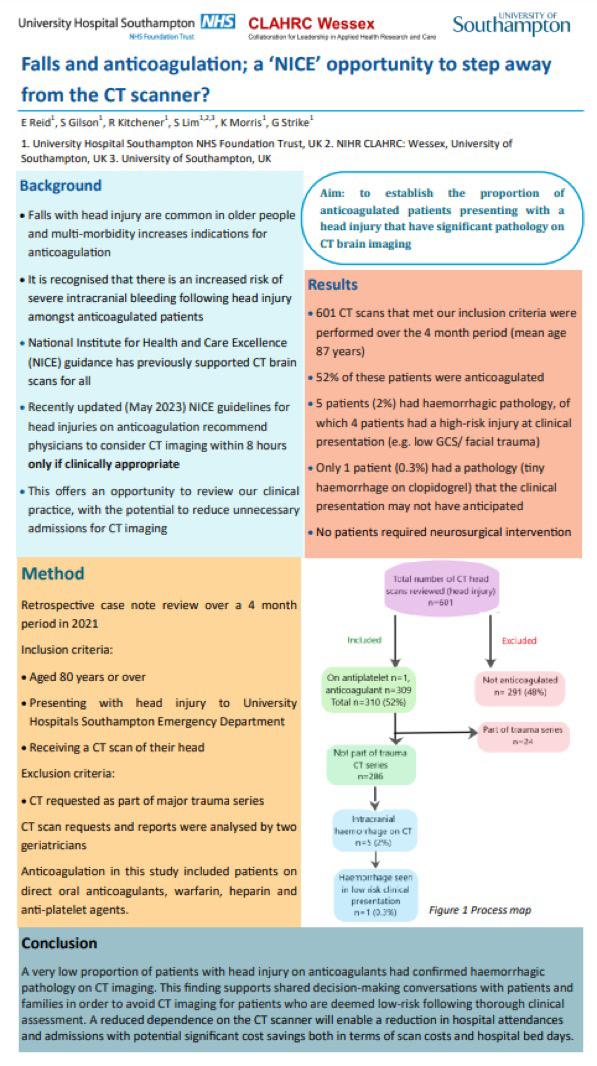
- 52% were anticoagulated
- 5 patients (2%) had haemorrhagic pathology, of which 4 had a high-risk mechanism/ presentation (eg low GCS)
- Only 1 patient had pathology that the clinical presentation did not anticipate
- No patient required neurosurgical intervention
This suggests that most older patients with low risk mechanisms and presenting symptoms, even those on anticoagulation, do not have haemorrhagic pathology and do not require neurosurgical intervention.
Head Injuries on anticoagulation or anti-platelet treatment
The British Geriatrics Society, Royal College of Emergency Medicine, Association of Ambulance Chief Executives and the Society of British Neurological Surgeons recently (October 2023) published a Position statement on the 2023 NICE head injury guidelines regarding asymptomatic patients on anticoagulation or antiplatelet treatment.
This statement supports taking a patient centred approach. They specifically state: "staying in their own home rather than being transferred to hospital or having a CT scan may be
more of a priority to the patient than the detection of a potential intracranial haemorrhage and should be given equal consideration."
There is no clear-cut guidance on whether to pause or hold anticoagulants following a head injury. However, the statement advises that: "in the majority of patients, a temporary pause of anticoagulation use will be necessary. This may involve accessing senior clinical support". This decision needs to be based on the risks and benefits of ongoing anticoagulation or antiplatelet use, the nature of the head injury, and falls risk. For Frailty-ACE work, we suggest the ED departments are the first port of call for advice on this.
The Emergency Department consultant advice lines can be accessed throughout ACE operating hours to seek senior ED clinical advice about injuries (or other ED-related presentations) if required.
- BRI ED consultant: 07345 463679
- NBT ED consultant:0117 4143021
- Weston ED Consultant: 07393 268850 (ext 7901)
Prescribing, and deprescribing, in frailty
More people aged 65+ are on eight or more medications, but only about 50% take medications as prescribed. 10-15% of admissions for people aged 65+ are associated with medications. Medicines are a major and modifiable risk factor for falls.
Therefore, prescribing issues and deprescribing recommendations are likely to be relevant for many F-ACE patients. Consider the patient’s individual priorities, level of frailty, goals of treatment, benefits and risks. However, F-ACE clinicians cannot modify the patient’s repeat medications on EMIS, so medication considerations will usually need to form part of the management plan with a request for General Practice teams to action. Suggested actions logged in the F-ACE plan might include
- Request for a structured medication review
- Specific suggested medication changes based on frailty-related considerations, the patient’s priorities and the acute presentation triggering the F-ACE intervention. The following are useful tools/ resources which may inform those requests/ recommendations
- Consideration of dispensing aids eg dosette
- Verbal advice about immediate recommendations, be they short or longer term
Useful prescribing guidance
- British Geriatric Society Pragmatic prescribing in moderate to severe frailty https://www.bgs.org.uk/PragmaticPrescribing
- BSW Prescribing Guidance for Moderately to Severely Frail Patients https://bswtogether.org.uk/medicines/wp-content/uploads/sites/3/2024/03/BSW-Frailty-Prescribing-Guidance-Feb-2024-update-FINAL.pdf#:~:text=Prescribe%20oral%20bisphosphonates%2C%20or%20iv%20zoledronic%20acid%2C%20if,initiating%20anti-resorptive%20drugs%20in%20last%20year%20of%20life.
- Anticholinergic burden (ACB) - acbcalc.com or medichec.com
- deprescribing.org
- Medication considerations following a fall, or when at risk of falls
- STOPPFall is an evidence-based approach to prescribing/ deprescribing in falls, and the STOPPFall decision trees are a helpful online tool
- ‘Fall Risk Increasing Drugs’ (FRID) include antidepressants, antipsychotics, diuretics, opioids, sedatives/ hypnotics including benzodiazepines
- Assess/ manage fracture risk as part of falls risk management
- benzo.org.uk structured approach to slow benzodiazepine reduction (Ashton protocol)
- Anticholinergic burden (ACB) - acbcalc.com or medichec.com
- The British Geriatric Society summarises the key messages in the World Fall Guideline (published in 2022)