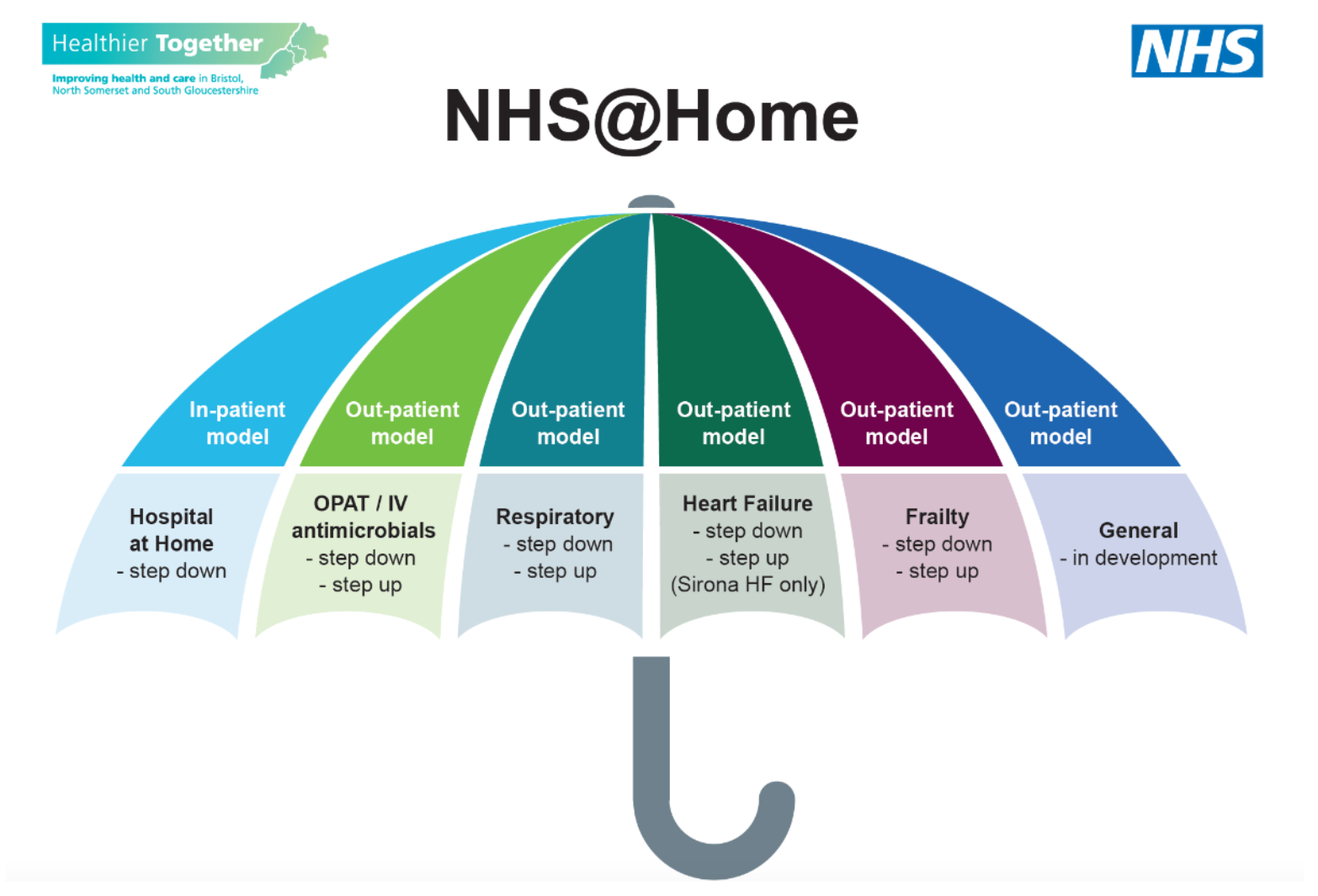
NHS@Home provides clinical care for people who are acutely unwell in their own homes, as an alternative to hospital admission, or to support earlier discharge from hospital.
The service enables people to get the care they need at home safely and conveniently, rather than being in hospital.
Referrals
Referrals can be made 7 days a week (8am-8pm) by contacting the NHS@ Home hub on 0300 125 5001.
Key eligibility requirements for all NHS@Home pathways:
- Patient has been seen F2F by HCP on day of referral
- Pt / carer willing to consider NHS@Home options & able to call for help if worsening symptoms
- NEWS 5 or under (clinical discretion can be applied)
- Are well enough to have the next NHS@Home F2F review the following day (same day referral visits are dependent on capacity)
Full details can be found here on Remedy
There are additional requirements for each of the specific pathways
Specific Pathways
Community referrals into NHS@Home are currently into 3 pathways, the details of which can be found in the respective links below:
Interventions offered
NHS@Home uses a mixture of digital monitoring on a virtual ward, telephone support and face to face visits from specialist teams. The specialist service has access to support from acute consultants.
- Digital monitoring records patient observations & digitally transfers these to a dashboard monitored by the NHS@Home clinical team.
- Patients can contact the NHS@Home clinical team if they have concerns or queries, and/ or deteriorating observations will trigger clinical review.
- This may be by telephone, but the ACP can also visit patients in their homes to undertake a face to face clinical assessment if required.
- The NHS@Home team operates 8am-8pm, 7 days a week.
Further interventions available are detailed below.
|
|
|
|
|||||
SevernSide IUC Support for NHS@Home in OOH
During the out of hours period, the NHS@Home clinicians have access to the Severnside Professional Line for advice and support. We anticipate that this will be needed infrequently. If we receive cases they will have an ‘HCP’ case type, with a ‘Virtual Wards/ NHS@Home’ relationship to caller, and these labels will be visible on the advice screen.
During weekday professional line opening hours we also take calls from the NHS@ Home teams when medical admissions are being sought for this cohort.
Out of hours queries may relate to acute primary care needs that are unrelated to the reason(s) the patient is receiving NHS@Home care, or be more directly related to the reason(s) the patient is under the care of NHS@Home.
Either way, please support clinical decision making as you would with any other community healthcare professional, including consideration of speaking directly with the patient/ their carer if needed. The NHS@Home clinician will also know how to access advice/ support from the specialist team overseeing the patient’s virtual ward care, if this is required.